Mmol/L to Mg/dL – Conversion Formula, Chart & Guide
Blood glucose monitoring spans two measurement systems. Millimoles per liter (mmol/L) dominates Europe, Asia, and Commonwealth nations, while milligrams per deciliter (mg/dL) remains standard across the United States and Canada. For patients traveling, consulting international research, or switching glucose meters, converting between these units becomes essential.
The conversion relies on the molecular weight of glucose. One millimole of glucose weighs 180.156 milligrams. Because the units measure different properties—molar concentration versus mass concentration—the conversion requires a fixed mathematical factor rather than a simple ratio. Understanding this calculation ensures accurate interpretation of fasting, postprandial, and glycated hemoglobin estimates regardless of regional reporting standards.
This guide provides the exact formula, reference tables, and clinical context necessary to move between mmol/L and mg/dL with precision. Whether interpreting laboratory results from a London clinic or configuring a new monitoring device purchased in New York, the following methods maintain diagnostic accuracy.
How Do You Convert mmol/L to mg/dL?
- mmol/L: Millimoles per liter (SI unit, common in UK/EU)
- mg/dL: Milligrams per deciliter (US standard)
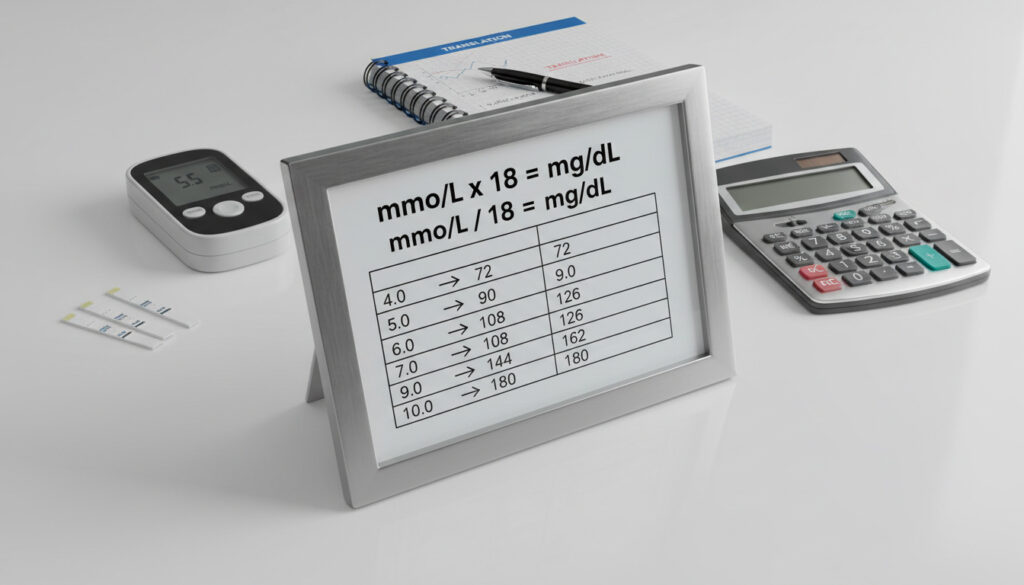
- Factor: Multiply mmol/L by 18
- Application: Diabetes blood glucose monitoring
Multiplying any mmol/L value by 18 yields the mg/dL equivalent. For scientific precision, use 18.018, derived from glucose’s exact molecular weight of 180.156 g/mol. OmniCalculator confirms this factor accounts for the conversion between molar mass and mass concentration across different volume units (liter to deciliter).
- Exact formula: mg/dL = mmol/L × 18
- Precision: No rounding needed for clinical accuracy
- Geography: US uses mg/dL; most world uses mmol/L
- Critical need: Essential for travel or device compatibility
- Molecular basis: Based on glucose molar mass of 180.156 g/mol
- Verification: Always check meter settings when switching regions
- Medical impact: Incorrect conversion affects insulin dosing decisions
| mmol/L | mg/dL | Fasting Normal? | Clinical Interpretation |
|---|---|---|---|
| 3.9 | 70 | Yes | Optimal lower bound |
| 4.0 | 72 | Yes | Normal fasting |
| 4.4 | 79 | Yes | Normal range |
| 5.0 | 90 | Yes | Normal upper |
| 5.5 | 99 | Borderline | Pre-diabetes threshold |
| 5.6 | 101 | No | ADA pre-diabetes cut-off |
| 6.1 | 110 | No | Pre-diabetes range |
| 7.0 | 126 | No | Diabetes threshold |
| 7.8 | 140 | No | Post-meal elevated |
| 11.1 | 200 | No | 2-hour OGTT diabetes threshold |
mmol/L to mg/dL Conversion Chart and Table
What Is a mmol/L to mg/dL Conversion Chart?
A conversion chart maps equivalent values across the two measurement systems without requiring calculation. Meto health resources provide visual grids showing parallel columns for mmol/L and mg/dL, typically ranging from hypoglycemic levels (3.0 mmol/L or 54 mg/dL) through hyperglycemic emergencies (20+ mmol/L or 360+ mg/dL).
Blood Glucose Conversion Table Standards
Reference tables vary by source jurisdiction. Diabetes UK publishes charts aligned with WHO criteria, emphasizing mmol/L as the primary column with mg/dL as secondary. American sources typically invert this hierarchy. Both formats maintain identical mathematical relationships despite differing presentation orders.
To convert mmol/L to mg/dL mentally, multiply by 18. For 5 mmol/L, calculate 5 × 18 = 90 mg/dL. For precise clinical work, use the factor 18.018 based on glucose’s exact molecular weight of 180.156 g/mol.
Common Blood Glucose Conversions (Examples)
What Is 5 mmol/L in mg/dL?
Five millimoles per liter equals exactly 90 milligrams per deciliter using the standard conversion factor. This value sits within the normal fasting range for non-diabetic adults. Nutrisense confirms this conversion as the upper normal limit before pre-diabetes thresholds.
What Is 10 mmol/L in mg/dL?
Ten millimoles per liter converts to 180 milligrams per deciliter. According to Disabled World charts, this represents a high reading typical of postprandial peaks in uncontrolled diabetes or stress hyperglycemia.
Critical Diagnostic Thresholds
Seven millimoles per liter—the diabetes diagnosis cutoff—equals 126 mg/dL. Eleven millimoles per liter, the two-hour oral glucose tolerance test threshold for diabetes, converts to 198 mg/dL (commonly rounded to 200 mg/dL in American guidelines).
mg/dL to mmol/L: Reverse Conversion
Converting from mg/dL to mmol/L requires dividing by 18 or multiplying by 0.0555. The formula reads: mmol/L = mg/dL ÷ 18. For example, 126 mg/dL ÷ 18 = 7.0 mmol/L, the established diabetes diagnosis threshold.
Clinicians often use the precise factor 0.0555 for calculator entries, derived from 1/18.018. NCBI’s StatPearls notes that this reverse calculation proves essential when interpreting American laboratory results using international diagnostic criteria.
Blood glucose meters manufactured for the US market display mg/dL by default. Devices sold in the UK, EU, and Australia display mmol/L. Switching units in device settings usually requires accessing the configuration menu; consult the manual to avoid misinterpretation during travel.
A reading of 6.0 mmol/L equals 108 mg/dL—normal in mmol/L but potentially confused with 60 mg/dL if units are misread. Always verify the unit indicator on the display screen before making treatment decisions.
Evolution of Blood Glucose Measurement Standards
- : US clinical laboratories adopt mg/dL based on mass concentration standards prevalent in American medical practice.
- : The International System of Units (SI) standardization campaign introduces mmol/L as the scientific standard for molar concentration.
- : European and Commonwealth nations transition to mmol/L for laboratory reporting, while the US maintains mg/dL.
- : The dual-system landscape persists, with Selph UK and Disabled World maintaining parallel reference charts. Costco Vega Protein Powder Recall – Affected Lots and Return Guide demonstrates how product safety standards differ by region, much like glucose reporting.
Scientific Certainty and Conversion Precision
| Established Information | Information That Remains Unclear |
|---|---|
| Conversion formula derives from glucose molecular weight: 180.156 g/mol | None; exact math with no biological variability |
| 1 mmol/L equals exactly 18 mg/dL after unit adjustment | Minor rounding differences (18 vs 18.018) clinically insignificant except in research |
| Mathematical relationship is universal and constant | Individual meter calibration may vary ±15% per FDA guidelines |
| ADA and WHO accept identical thresholds after conversion | Patient-specific glycemic variability factors |
Normal Blood Sugar Ranges and Global Standards
The United States and Canada predominantly report blood glucose in mg/dL, a practice rooted in historical laboratory instrumentation. Conversely, the United Kingdom, European Union member states, Australia, and South Africa use mmol/L exclusively. CO2 Laser Before and After – Real Results and Recovery Timeline illustrates how medical standards require precise measurement, much like glucose monitoring. Per convertir entre mmol/L i mg/dL, que són els dos sistemes de mesura de la glucosa en sang utilitzats a diferents països, podeu consultar la fórmula de conversió, el gràfic i la guia a cartexan ja verenpaine.
Normal fasting blood glucose spans 4.0 to 5.5 mmol/L (72 to 99 mg/dL). The American Diabetes Association defines diabetes at ≥7.0 mmol/L (≥126 mg/dL), while prediabetes falls between 5.6 and 6.9 mmol/L (100–125 mg/dL).
Patients using continuous monitoring systems should verify their app’s unit settings match their meter. Discrepancies between mg/dL and mmol/L in automated reports can lead to confusion when sharing data with healthcare providers trained in different regional standards.
Medical Authority and Source Verification
The conversion factor between mmol/L and mg/dL is based on the molecular weight of glucose (180.156 g/mol), where 1 mmol/L equals 18 mg/dL.
— NCBI StatPearls, Glucose Monitoring
To convert mmol/L to mg/dL, you multiply the value by 18.018 for scientific precision or 18 for clinical practice.
— OmniCalculator Health Division
Summary and Key Takeaways
Converting mmol/L to mg/dL requires multiplying by 18, while the reverse conversion divides by 18 or multiplies by 0.0555. These fixed formulas, derived from glucose’s molecular weight of 180.156 g/mol, enable accurate interpretation of blood sugar readings across the US, UK, and global medical systems. Always verify device unit settings and consult healthcare providers when readings approach diagnostic thresholds.
Frequently Asked Questions
What does mmol/L stand for?
mmol/L stands for millimoles per liter, a unit measuring the concentration of glucose in blood based on molecular count.
Why use mg/dL vs mmol/L?
The US and Canada use mg/dL historically, while the UK, EU, and most of the world adopted mmol/L during 1970s SI standardization.
Is 6 mmol/L high?
Six mmol/L equals 108 mg/dL, which falls within normal fasting ranges but approaches the pre-diabetes threshold of 5.6 mmol/L.
Can I use an online calculator?
Yes, calculators from OmniCalculator or Diabetes UK provide instant conversion, though mental math (×18) works for quick estimates.
What is the precise conversion factor?
Scientific precision uses 18.018 (based on glucose’s 180.156 g/mol weight), though 18 suffices for clinical glucose monitoring.
More related posts
 15000 CAD to USD: Live Rates, Converter & Providers
 Grand Theft Auto 6: 2026 Release Date, Rumors & Facts
 Sharks vs Maple Leafs: Predictions, Stats & Head-to-Head
 How Great Thou Art Lyrics: Meaning, Story, and Funeral Use
 What Is a Drip Irrigation System? Definition and Benefits
 Argan Oil for Hair – Science-Backed Benefits and Uses
 McDonald’s 50 Cent Cheeseburger Day: How to Get the Deal
 Uniprix Circulaire Semaine Prochaine: Next Week’s Flyer
