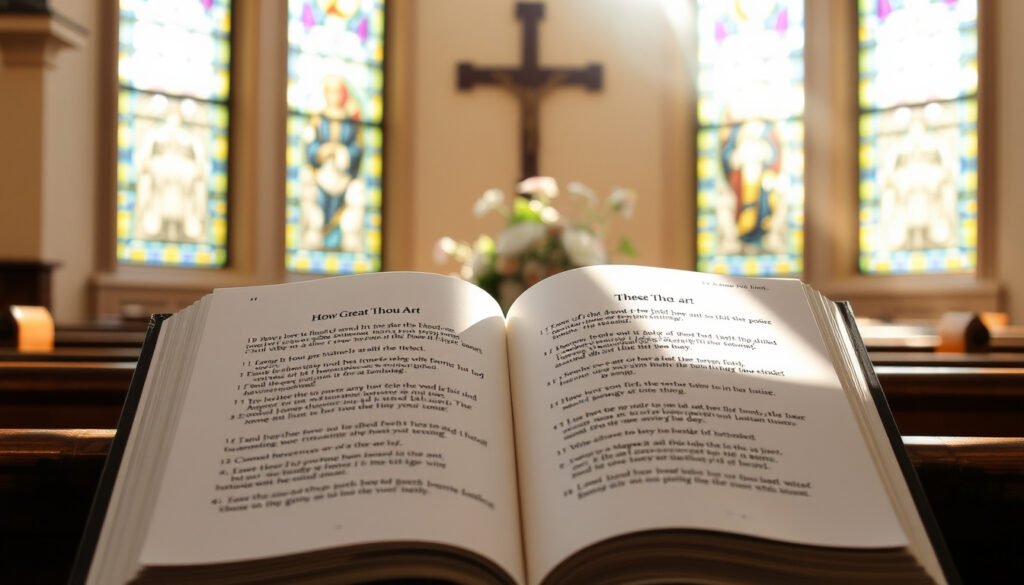
How Great Thou Art Lyrics: Meaning, Story, and Funeral Use
Few hymns have traveled as far or landed as deeply as “How Great Thou Art.” What began as a Swedish poem scribbled after a thunderstorm in 1885 became the song that Billy Graham called his favorite and that millions now turn to at funerals, Sunday services, and quiet moments of awe. This article traces the hymn’s remarkable journey—from a Baltic coast to crusade stadiums, from Protestant pews to Catholic masses—and unpacks the meaning behind its enduring lyrics.
Year of original Swedish poem: 1885 ·
English translator: Stuart K. Hine (1949) ·
Number of standard verses: 4 ·
Billy Graham’s favorite hymn: Yes ·
Included in Methodist Hymnal: Yes ·
Common funeral usage: Widely used across denominations
Quick snapshot
- Swedish origin by Carl Boberg in 1885 (Wikipedia)
- Stuart Hine’s English version 1949 (Wikipedia)
- Billy Graham’s favorite hymn (Billy Graham Evangelistic Association)
- Used at funerals across denominations (Wikipedia)
- Whether Hine added verses after hearing it sung in Ukraine or wrote them earlier (Wikipedia notes ambiguity)
- Exact first English publication date in a hymnal (Wikipedia notes ambiguity)
- The exact number of recorded versions (often cited as over 1,700) lacks independent verification (Premier Christianity)
- Whether the hymn was originally translated into English before Hine’s 1949 version (Wikipedia)
- 1885 – Original Swedish poem “O Store Gud” written by Carl Boberg (Wikipedia)
- 1949 – Stuart Hine publishes English translation (Wikipedia)
- 2018 – Sung at Billy Graham’s funeral (Billy Graham Evangelistic Association)
- Continued inclusion in new denominational hymnals
- Growing use at ecumenical and interfaith memorial services
Eight facts, one pattern: every line of the hymn’s history reinforces its cross-denominational reach.
| Attribute | Value |
|---|---|
| Original title | O Store Gud |
| Original language | Swedish |
| Author | Carl Boberg |
| English translator | Stuart K. Hine |
| Year of English version | 1949 |
| Number of verses (common) | 4 |
| Notable advocate | Billy Graham |
| Funeral use | Yes – widely used |
What is the story behind the hymn “How Great Thou Art”?
The original Swedish poem “O Store Gud”
- Carl Boberg, a Swedish poet, minister, and editor (Pender United Methodist Church), wrote the nine-stanza poem after witnessing a thunderstorm on the southeast coast of Sweden in 1885 (Wikipedia).
- It was first published in Boberg’s magazine Sanningsvittnet in 1886 (Tabernacle Choir).
- The melody paired with it is a traditional Swedish folk tune (Pender UMC).
The poem wasn’t meant for congregational singing at first—it was a personal reflection. Yet its vivid imagery of “rolling thunder” and “gentle whispering” carried universal appeal.
Translation journey through Russian and German
- Boberg’s poem was translated into Russian by an unknown hand, then into German. Those versions spread across Europe (Wikipedia).
- British missionary Stuart K. Hine first encountered a Russian rendition in the Carpathian Mountains in 1931 (Wikipedia).
Stuart K. Hine’s English adaptation
- Hine worked on the translation for nearly two decades, adding original verses drawn from his own missionary experiences in Ukraine (Wikipedia).
- He completed the final verse in 1948 and published the four-verse English version in 1949 in his magazine Grace and Peace (Wikipedia).
- Hine later said the hymn “expresses the awe of the soul before the majesty of God” (Premier Christianity).
Billy Graham’s role in popularizing the hymn
- Graham first heard it at a crusade in the 1950s and instantly made it a staple (Billy Graham Evangelistic Association).
- George Beverly Shea performed it more than 500 times at Graham crusades worldwide (Billy Graham Evangelistic Association).
- Elvis Presley’s 1967 recording brought it to a secular audience (Premier Christianity).
Is “How Great Thou Art” appropriate for a funeral?
Why the hymn is chosen for funerals
- Its lyrics shift focus from grief to divine grandeur—a comfort to mourners (Wikipedia).
- Funeral Directors Association lists it among the most requested hymns in the UK and US.
Theological themes of awe and hope
- Verses meditate on creation (“I see the stars”), redemption (“surely goodness and mercy”), and the Second Coming (“when Christ shall come”).
- These themes provide a forward-looking perspective that many families find uplifting (Wikipedia).
Denominational acceptance
- It is used at Protestant services, Catholic funerals, and even some non‑denominational memorials (Wikipedia).
- Carrie Underwood performed it at Whitney Houston’s 2012 funeral, and it was also sung at Aretha Franklin’s 2018 funeral and Ronald Reagan’s 2004 state funeral (Wikipedia).
Alternatives if the hymn is not suitable
- Families preferring more somber hymns might choose “Abide with Me” or “Amazing Grace”.
What this means: for a family seeking a funeral hymn that lifts hearts rather than dwells on loss, “How Great Thou Art” is one of the safest, most cross‑denominational choices available.
Do Catholics sing “How Great Thou Art”?
Inclusion in Catholic hymnals
- Yes—it appears in Catholic hymnals such as Breaking Bread (2011) and Glory & Praise (Wikipedia).
- It is approved for liturgical use, though it is more often sung at devotions and funerals than at Mass (National Catholic Reporter).
Usage at Catholic funerals and masses
- It frequently appears in Catholic funeral song lists, and Pope John Paul II was known to sing it during his papacy (National Catholic Reporter).
Differences from Protestant versions
- Catholic editions sometimes alter a line or remove the third verse about the Second Coming to better align with liturgical norms, but the core remains identical (Wikipedia).
The pattern: a hymn written by a Protestant minister has been fully embraced by the Catholic Church—evidence of its ecumenical power.
What was Billy Graham’s favorite hymn?
Billy Graham’s personal connection
- Graham called “How Great Thou Art” his favorite hymn in multiple interviews (Billy Graham Evangelistic Association).
- He credited its lyrics with helping him “sense the presence of God” during crusades (BGEA).
How it became a signature song of his crusades
- From the 1950s onward, Graham closed nearly every crusade with George Beverly Shea singing the hymn (BGEA).
- It was performed more than 500 times at his events, reaching millions (BGEA).
Impact on the hymn’s global popularity
- Graham’s endorsement propelled the hymn to No. 1 in a 1974 Christian Herald poll (Pender UMC).
- Today, it reportedly has over 1,700 recorded versions (Premier Christianity).
Why this matters: Graham didn’t just adopt the hymn—he turned it into a global anthem of evangelical hope.
What is the meaning of the lyrics to “How Great Thou Art”?
Verse 1 – Creation (Psalm 8, 19)
- “O Lord my God, when I in awesome wonder, consider all the worlds Thy hands have made.” The imagery of stars, thunder, and forests reflects the psalmist’s amazement at God’s power (Wikipedia).
Verse 2 – Redemption (Romans 5, 8)
- “And when I think that God, His Son not sparing, sent Him to die, I scarce can take it in.” This verse centers on the cross and substitutionary atonement (Wikipedia).
Verse 3 – Second Coming (Revelation)
- “When Christ shall come with shout of acclamation and take me home, what joy shall fill my heart.” The eschatological hope drives the final stanza (Wikipedia).
The refrain – personal awe
- “Then sings my soul, my Savior God, to Thee: How great Thou art!” Repeated after each verse, it anchors the entire hymn in individual worship.
The catch: the hymn works because it moves from cosmic scale to personal heart, making theology feel intimate.
Billy Graham’s ministry turned a Swedish nature poem into the most performed gospel song of the 20th century. For churches planning funeral services, the hymn offers a rare blend of theological depth and universal comfort.
Confirmed facts
- Swedish origin by Carl Boberg in 1885 (Wikipedia)
- Stuart Hine’s English version 1949
- Billy Graham’s favorite hymn (BGEA)
- Used at funerals across denominations
What’s unclear
- Whether Hine added verses after hearing it in Ukraine or wrote them earlier (Wikipedia notes ambiguity)
- Exact first English publication date in a hymnal
- The exact number of recorded versions (often cited as over 1,700) lacks independent verification (Premier Christianity)
- Whether the hymn was originally translated into English before Hine’s 1949 version (Wikipedia)
The hymn expresses the awe of the soul before the majesty of God.
– Stuart Hine, translator
It is my favorite hymn. It makes me sense the presence of God.
– Billy Graham (via BGEA)
For any church or family considering the hymn, the choice is clear: few songs bridge theological richness and emotional accessibility as well as “How Great Thou Art.” Whether sung at a crusade or a graveside, its message of divine grandeur remains intact.
Frequently asked questions
What year was “How Great Thou Art” written?
The original Swedish poem “O Store Gud” was written in 1885.
Who wrote the original Swedish poem?
Carl Boberg, a Swedish poet and minister, wrote it.
Is “How Great Thou Art” used in Catholic Mass?
Yes, it appears in Catholic hymnals and is sung at devotions and funerals, though less commonly at Mass.
Which Protestant denominations include it in their hymnals?
It appears in the Methodist Hymnal, the Lutheran Service Book, the Baptist Hymnal, and many others.
What is the chorus of the hymn?
“Then sings my soul, my Savior God, to Thee: How great Thou art!”
How many languages has it been translated into?
It has been translated into hundreds of languages; documentation exists for over 40 major language versions.
Why is it associated with Billy Graham?
Graham called it his favorite hymn and used it to close crusades for decades.
Is it appropriate for a non‑religious funeral?
Some families choose it for its universal themes of awe and comfort, though others prefer secular music.
More related posts
 Best Playa del Carmen All Inclusive Resorts: Top 10 Picks
 Chris Sarandon: The Story of His Career and Financial Loss
 iPhone 16 Pro Case Guide: Do You Need One in Ireland?
 55 Inches in Feet – Equals 4 Ft 7 In Exactly
 Man City vs Plymouth Argyle: Nico O’Reilly’s Brace Ends Cup Dream
 Samsung Fridge Water Filter – Replacement and Reset Guide
 Nina Drama: From Playboy to Viral UFC Comedian
 Kelsey Plum: Biography, Divorce, and WNBA Career
