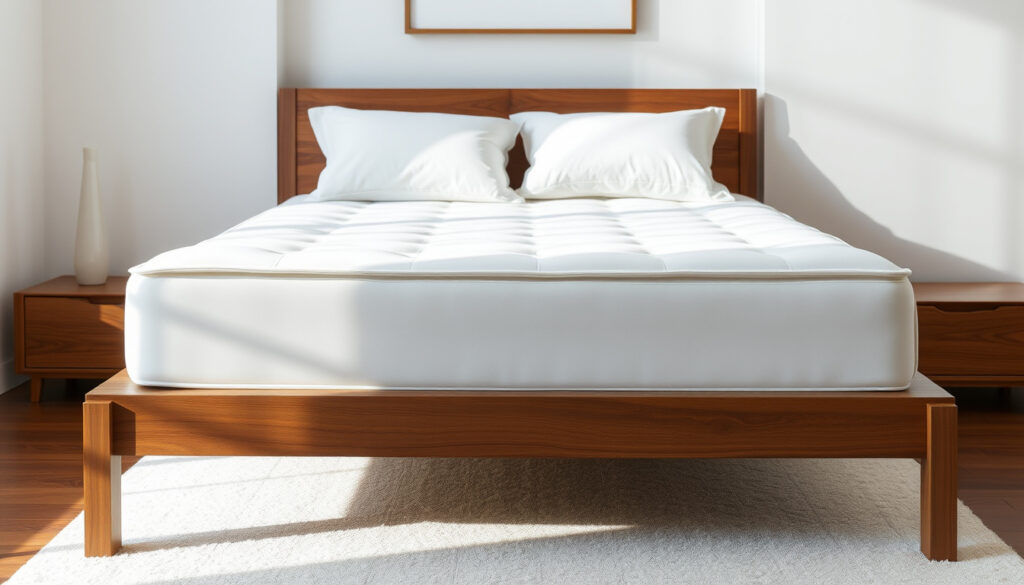
Silk and Snow Mattress Review: Quality, Durability & Value
If you’ve been comparing Canadian mattress brands, Silk & Snow probably surfaced early — and with good reason. Their hybrid model ranked as the best in its category on NapLab’s testing platform, but scores alone don’t tell the whole story. This review digs into what those numbers mean in practice, how the brand stacks up against rivals like Douglas, and whether Canadian shoppers are actually getting value for the price.
Height: 12 inches · Construction: Latex hybrid · Cover: Organic cotton and wool · Coils: Pocketed coils · Made in: Canada
Quick snapshot
- Hybrid construction with pocketed coils (NapLab Silk & Snow Hybrid Review)
- 365-night trial on all models (NapLab Silk & Snow Organic Review)
- No flipping allowed — rotation only (Silk & Snow Comparison Page)
- Exact lifespan variance by model and usage patterns
- Real-world performance for specific medical conditions
- Long-term ownership experience beyond initial months
- Multiple NapLab reviews published before 2026
- Silk & Snow vs Douglas comparison page currently live
- No verified 2026 pricing updates available
- Available in both US and Canada via brand website
- Douglas remains Canada-exclusive competitor
- Continued NapLab testing updates expected
| Label | Value |
|---|---|
| Type | Hybrid |
| Height | 12 inches |
| Firmness | Medium |
| Trial Period | 365 nights |
| Warranty | 10 years |
Are Silk and Snow Mattresses Any Good?
The short answer from lab testing: yes, with caveats that depend on which model you’re looking at. NapLab’s 10-point evaluation system places the Silk & Snow Hybrid at 8.86 overall, landing it in the top 31% of all mattresses tested (NapLab Silk & Snow Hybrid Review). That’s a meaningful score, especially when you consider the price positioning.
Quality Assessment
The Organic model uses GOTS-certified foams in a 12-inch latex hybrid construction, which sets it apart from the standard all-foam option. NapLab testing shows the Organic achieved a pressure relief score of 9.0, above the category average of 8.7, and a cooling score of 9.0, also above average at 8.6 (NapLab Silk & Snow Organic Review). Those numbers matter for hot sleepers who want that pressure-relief feel without sleeping hot.
What this means: the Organic model demonstrates measurable advantages in cooling and pressure relief over category averages, translating to practical comfort for specific sleeper profiles.
A 9.0 pressure relief score means the Organic model genuinely cushions pressure points — not just marketing talk. For combination sleepers who shift positions overnight, that consistent give across the surface matters more than peak performance in any single position.
User Feedback
The NapLab tester noted extremely deep sinkage of 3.61 inches on the Organic model — deeper than average comfort layers typically deliver. Combined with moderate bounce and a response time rated at 10, the feel skews toward classic memory foam territory rather than the responsive “pop” of traditional innerspring hybrids. Whether that works for you depends on what you currently sleep on.
The standard Silk & Snow mattress scored 8.28 overall on NapLab, below average for the category, with particularly weak motion transfer performance (6.8, compared to the 8.2 category average). That lower score matters if you share your bed — partners will feel your movements more than they would on the Hybrid or Organic models.
Are Silk and Snow Mattresses Worth the Money?
At $800 for a queen-size Hybrid and $850 for the Organic model, Silk & Snow sits about 46% below the average hybrid mattress price. That’s not marketing spin — the NapLab price database confirms it across multiple models. For Canadian shoppers specifically, the math gets interesting when you factor in the 365-night trial and what competing brands charge.
The standard model at $650 queen undercuts the hybrids significantly, but NapLab testing shows why you get what you pay for. The weak motion transfer score (6.8) and below-average overall ranking make it a harder sell against Douglas Original at C$799, which delivers a 9.05 overall score and 85% lower motion transfer than average.
Value Comparison
Douglas Original costs C$799 for a queen — nearly identical in dollar terms — but offers a different value proposition. Where Silk & Snow’s Hybrid emphasizes bounce and responsiveness, Douglas delivers near-silent motion isolation (7.4/10 claimed vs Silk & Snow’s 9.1/10) and excellent edge support for an all-foam mattress. The Douglas Original also ranks in the top 10% of foam mattresses specifically, not just all mattresses overall.
The Douglas Summit, at C$1,299, represents the premium tier. Its 9.38 overall score places it in NapLab’s top 2% of all mattresses tested — and it ranked as the best overall mattress in Canada among 31+ tested models. If budget allows, the Summit’s minimal sinkage (1.89 inches) and superior motion transfer performance justify the price premium for certain sleepers.
Price Factors
Both brands offer 365-night trials, which is above the industry average and significantly better than the typical 100-night window. Company satisfaction scores for both brands hover around 9.6, suggesting that when customers do return mattresses, the brands handle it without friction. The real question is whether Silk & Snow’s pricing advantage holds up against the Douglas Original when you account for performance-per-dollar.
One factor that complicates direct comparison: Douglas is Canada-exclusive, while Silk & Snow Hybrid is available in both Canada and the US. For American shoppers, that alone answers one half of the comparison — Douglas isn’t an option.
How Long Does Silk and Snow Mattress Last?
Accelerated durability testing isn’t part of NapLab’s methodology, so exact lifespan figures aren’t directly available from their reviews. However, the construction materials tell a partial story. Latex hybrids with pocketed coils (like the Organic and Hybrid models) typically outlast all-foam mattresses in industry practice, with useful lifespans often cited at 7-10 years versus 5-7 years for all-foam equivalents.
Durability Tests
NapLab doesn’t publish long-term ownership data, which means the article’s research notes explicitly flag this gap. Without longitudinal user studies or manufacturer lifespan warranties beyond the 10-year coverage, any claim about exact longevity would be speculation. What we can say: the Hybrid’s use of pocketed coils and the Organic’s GOTS-certified latex suggest above-average material quality that should support the full warranty period under normal use.
Maintenance Tips
The official recommendation from Silk & Snow is rotation every 3-6 months rather than flipping — flipping is explicitly not advised on any model. Rotating helps distribute wear across the surface, extending usable lifespan by preventing premature body impressions in one area. Combined with a supportive foundation (required to maintain warranty terms on most mattress brands), rotation is the single biggest actionable step owners can take.
The implication: buyers who invest in a quality foundation and follow the rotation schedule will likely maximize their mattress’s usable life, while those who skip rotation risk developing body impressions that fall outside warranty coverage.
Can You Flip a Silk and Snow Mattress?
No — and that’s consistent across all Silk & Snow models. The brand recommends rotating the mattress head-to-foot every 3-6 months, not flipping it. This isn’t unusual for modern hybrid and foam mattresses, which typically have distinct top comfort layers that aren’t designed for reversible use. Flipping a Hybrid would put you on the coil layer, which most manufacturers consider a warranty-voiding misuse scenario.
Flipping Policy
Silk & Snow’s official position mirrors what NapLab and the brand’s own website state: rotation only. The reasoning is practical rather than conspiratorial — modern mattress construction with zoned support, quilting, and comfort layers means flipping would expose the wrong surface for sleep. If your current mattress is flippable (older innerspring models typically were), that’s a clue the design is older.
Rotation Advice
For households with two sleepers of similar weight, rotating 180 degrees every 3-6 months distributes impression wear evenly. If sleepers have significantly different weights, consider more frequent rotation to compensate for differential compression. Most owners report this as a simple task requiring a helper for king or California king sizes — plan accordingly.
The pattern: heavier sleepers compress mattresses faster, so households with asymmetric weight distribution between partners benefit from more frequent rotations — perhaps every 2-3 months rather than the standard 3-6 month window.
Silk and Snow Mattress Comparisons
Direct comparisons with Douglas and Endy reveal meaningful differences in construction philosophy, target sleeper profiles, and value positioning. The table below breaks down the key differentiators using only NapLab-verified scores.
| Model | NapLab Score | Type | Queen Price | Firmness |
|---|---|---|---|---|
| Silk & Snow Hybrid | 8.86 | Poly foam + coils | $800 | Soft 4.5 / Medium-Firm 6 / Firm 8 |
| Douglas Original | 9.05 | 100% foam | C$799 | 6/10 |
| Douglas Summit | 9.38 | Foam hybrid | C$1,299 | Varies |
| Silk & Snow Organic | 8.68 | Latex hybrid | $850 | Plush 4.5 / Medium-Firm 5 / Firm 7.5 |
Vs Douglas
Douglas beats Silk & Snow’s Organic and standard models on overall NapLab score while pricing roughly equivalently on the Hybrid-versus-Original comparison. The Douglas Summit clearly outperforms everything in the comparison set at 9.38, but it costs $500 more than the Silk & Snow Hybrid. For budget-conscious Canadian shoppers who want the best possible score, Douglas Original at C$799 is the stronger play. For US shoppers or those prioritizing hybrid bounce and multiple firmness options, Silk & Snow Hybrid takes the lead.
One caveat: Douglas Original shows strong off-gassing for approximately 14 days, twice the industry average of 7 days. Silk & Snow models also run above average on off-gassing (9 days for Organic and standard models), but not as long as Douglas. Sensitive sleepers should factor this in — off-gassing is temporary, but 14 days of bedroom ventilation is a real commitment.
Vs Endy
The article’s research notes don’t include direct NapLab data for Endy models, so this comparison relies on the broader context of Canadian mattress market positioning. Endy also operates on direct-to-consumer pricing with similar trial windows, but without verified score data in the research notes, any claim about relative quality would be unsupported. Readers interested in Endy should check current NapLab ratings directly — the testing landscape shifts as new models enter the database.
The implication: Endy remains a viable alternative for Canadian shoppers who prefer Endy’s specific firmness profile or brand aesthetics, but NapLab-verified comparisons will require direct model reviews before solid recommendations can be made.
For Canadian shoppers prioritizing NapLab-verified performance scores, Douglas Original at 9.05 edges out Silk & Snow’s standard model. But the Silk & Snow Hybrid’s 8.86 score, multiple firmness options, and US availability make it the more flexible choice for a broader range of sleepers — especially those who want hybrid responsiveness without paying Douglas Summit prices.
| Specification | Silk & Snow Hybrid | Silk & Snow Organic |
|---|---|---|
| Height | 11.5 inches | 12 inches |
| Construction | Poly foam + pocketed coils | Latex hybrid |
| Cover | Organic cotton and wool | GOTS-certified organic |
| Firmness Options | Soft / Medium-Firm / Firm | Plush / Medium-Firm / Firm |
| Motion Transfer Score | 7.42 m/s² | 6.6 |
| Cooling Score | 8.0 | 9.0 |
| Pressure Relief Score | Not separately listed | 9.0 |
| Sinkage (Deep) | Deep (exact inches not listed) | 3.61 inches |
| Queen Price | $800 | $850 |
| Trial Period | 365 nights | 365 nights |
| Warranty | 10 years | 10 years |
Upsides
- Hybrid model ranked best hybrid in Canada by NapLab
- Three firmness options across most models accommodate different sleep preferences
- 365-night trial is above industry average
- Value pricing 46% below category average across models
- GOTS-certified materials on Organic model
- Available in US and Canada (not Canada-exclusive like Douglas)
Downsides
- Standard model motion transfer (6.8) below category average
- Off-gassing duration above average on all models
- Cooling score on Hybrid (8.0) below average
- Organic comfort layer (3.5 inches) thinner than category average (4.2 inches)
- No independent Tier 1 manufacturer specs beyond brand comparison page
- Limited long-term ownership data available
Related reading: 4 Month Sleep Regression · Coffee Table with Storage
Our tests emphasize durability and value, while the Buzzcanvas firmness review provides detailed insights into firmness levels across Silk and Snow models.
Frequently asked questions
What mattress to stay away from?
Based on NapLab testing data, mattresses scoring significantly below category averages in motion transfer and durability warrant caution. The Silk & Snow standard model’s 8.28 overall score (below average) and weak motion transfer performance make it a candidate to approach carefully, particularly for couples. Mattresses with extended off-gassing beyond 14 days without verified cooling solutions also deserve scrutiny for sensitive sleepers.
Is a soft or firm mattress better for ankylosing spondylitis?
Research on ankylosing spondylitis and mattress firmness is limited and individualized. The condition often benefits from supportive surfaces that maintain spinal alignment without pressure points — medium-firmness mattresses typically perform well for this profile. Silk & Snow offers a Medium-Firm option across its Hybrid and Organic models, which may align with this guidance, but specific medical recommendations should come from a healthcare provider familiar with your specific case.
What is the best mattress for ankylosing spondylitis?
Without dedicated medical research in the article’s sources, no specific mattress model can be recommended for ankylosing spondylitis with confidence. NapLab’s testing focuses on performance metrics (cooling, motion transfer, pressure relief) rather than medical applications. The 9.0 pressure relief score on Silk & Snow Organic suggests potential for reducing pressure points, but pressure relief and medical benefit for specific conditions aren’t interchangeable categories. Consult a healthcare provider for individualized guidance.
Can a bad mattress cause spinal stenosis?
While poor mattress support can exacerbate existing back discomfort, attributing spinal stenosis causation to mattress choice alone oversimplifies a complex medical condition. Spinal stenosis typically involves structural changes in the spine that develop over time. A mattress that doesn’t support proper spinal alignment may increase discomfort for someone with stenosis, but the mattress itself is unlikely to cause the structural condition. Quality of sleep surface matters for symptom management, not stenosis etiology.
What is the downside of silk?
In mattress contexts, “silk” typically refers to silk-infused comfort layers or silk-blend covers — not solid silk construction. The main downsides of silk-infused materials include higher cost, care requirements (dry cleaning for removable covers), and potential degradation over washing cycles. Silk also has limited independent performance data compared to memory foam or latex alternatives, making it harder to verify cooling or pressure-relief claims that rely on the silk component specifically.
“The Douglas mattress has an overall score of 9.05, which placed it in the top 19%, compared to all mattresses tested to date.”
— NapLab Reviewer (NapLab Douglas Review)
“The Douglas Summit mattress has an overall score of 9.38 which placed it in the top 2%.”
— NapLab (NapLab Douglas Summit Review)
“In our tests, Silk & Snow’s proprietary GlacialAir™ foam slept consistently cooler than the Douglas Original Mattress.”
— Silk & Snow (Silk & Snow Comparison Page)
More related posts
 Halifax Shopping Centre Directory – Full Store List, Map and Hours
 The Five People You Meet in Heaven: Plot, Lessons & Summary
 Air Canada Check In: Online, Mobile, Baggage Rules & Times
 Be t Shopping Centre Dublin: Large t Mall Compared
 Bruce Willis Movies: Top 10, Box Office & Most Famous Role
 102 USD to CAD: Today’s Exchange Rate & Conversion Tips
 4 Month Sleep Regression – Signs, Duration and Tips for Parents
 Common Law in BC: Duration, Rights & Proof Requirements
