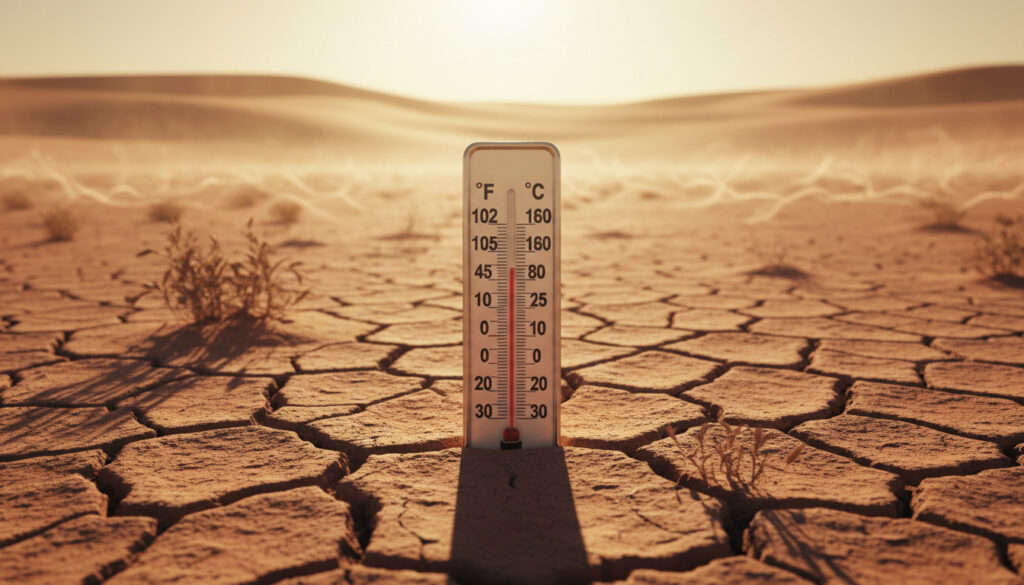
102 F to C – Exact Conversion Formula and Contexts
One hundred two degrees Fahrenheit translates precisely to 38.89 degrees Celsius using the international standard conversion formula. This temperature threshold carries significant weight across medical and meteorological contexts, often signaling dangerous fever levels in human health or extreme heat conditions in summer weather reports.
The conversion relies on a simple algebraic relationship between the two scales, yet the resulting value sits notably high on the Celsius scale—nearly 39 degrees above water’s freezing point. Understanding this specific measurement requires examining both the mathematical precision of the calculation and the practical implications of such heat.
Whether monitoring a child’s temperature during illness or interpreting forecast data during a heatwave, recognizing what 102°F represents in Celsius provides essential context for decision-making. The following sections break down the exact conversion process, historical development of these scales, and real-world applications of this critical temperature threshold.
What Is 102°F in Celsius?
- The precise calculation yields 38.888…°C, a repeating decimal mathematically equivalent to 38⅞°C
- NASA weather charts round this to 38.9°C for operational accuracy
- In medical contexts, this temperature indicates high fever, well above the typical 98.6°F (37°C) baseline
- Weather services classify 102°F as extreme heat, approaching heatwave thresholds common in desert climates
- The conversion formula °C = (°F – 32) × 5/9 is standardized by international measurement bodies
- No approximation is necessary for exact calculations, as the fraction 5/9 provides precise results
- Reverse calculation confirms 102°C equals 215.6°F, highlighting the non-linear relationship between scales
| Fahrenheit | 102°F |
| Celsius (Exact) | 38.888…°C |
| Celsius (Rounded) | 38.9°C |
| Kelvin | 312.04 K |
| Rankine | 561.67°R |
| Réaumur | 31.11°Re |
| Medical Context | High Fever |
| Weather Context | Extreme Heat |
How to Convert Fahrenheit to Celsius (Formula Explained)
The conversion from Fahrenheit to Celsius follows a standardized algebraic formula recognized by scientific institutions worldwide. Subtracting 32 from the Fahrenheit value accounts for the offset between the two scales’ zero points, while multiplying by 5/9 adjusts for their different unit sizes.
The International Standard Formula
Physicists and meteorologists apply the equation °C = (°F – 32) × 5/9, where five-ninths represents the ratio between the scales’ degree increments. Calculation tools verify that this formula maintains exact precision without rounding errors during the conversion process.
Step-by-Step Calculation for 102°F
Applying the formula to 102°F requires three distinct operations. First, subtract 32 from 102, yielding 70. Next, multiply 70 by 5, resulting in 350. Finally, divide 350 by 9 to obtain 38.888…, where the digit 8 repeats infinitely.
The fraction 350/9 produces an exact repeating decimal. For scientific applications requiring absolute precision, retaining the fractional form 38⅞°C eliminates rounding errors. Most weather and medical contexts accept 38.9°C as sufficiently accurate.
Is 102°F Hot? Celsius Context and Perception
Translating 102°F to 38.9°C places this temperature in dangerous territory for human physiology and comfort. On the Celsius scale, values approaching 40 degrees indicate environmental or bodily conditions that demand immediate attention.
Medical Interpretation
Human body temperature normally hovers near 98.6°F (37°C). Medical professionals typically classify readings above 100.4°F (38°C) as fever, making 102°F a high fever requiring monitoring. At 38.9°C, the body initiates aggressive immune responses, and prolonged exposure to such internal temperatures risks cellular damage.
Weather and Environmental Conditions
Ambient air temperatures of 102°F characterize severe heatwaves in regions like the southwestern United States or Mediterranean climates. Chicago Weather (38°F) demonstrates the dramatic range possible, with 102°F representing the opposite extreme. Outdoor activity becomes hazardous as heat stress and dehydration risks escalate rapidly above this threshold.
Thermal comfort scales categorize temperatures above 95°F as “sweltering.” At 102°F (38.9°C), the human body struggles to maintain core temperature through sweating alone, particularly when humidity exceeds 40 percent.
Reverse Conversion: 102°C to Fahrenheit
The inverse calculation—converting 102°C to Fahrenheit—yields dramatically different results that underscore the non-linear relationship between these scales. This reverse conversion rarely appears in medical contexts but proves essential in industrial applications or scientific experiments.
Applying the inverse formula °F = (°C × 9/5) + 32, one multiplies 102 by 1.8 to obtain 183.6, then adds 32 for a final result of 215.6°F. Conversion resources confirm this value exceeds the boiling point of water at standard atmospheric pressure, representing extreme heat used in sterilization processes or certain manufacturing environments.
Confusing 102°F with 102°C creates dangerous misinterpretations. While 102°F (38.9°C) indicates treatable fever, 102°C (215.6°F) exceeds water’s boiling point and causes immediate severe burns upon contact.
Development of Temperature Measurement
The history of thermal measurement follows a chronological path from arbitrary reference points to standardized scientific scales. Understanding this evolution clarifies why two major systems persist today with different zero points and increments.
- : Daniel Gabriel Fahrenheit establishes his scale using a mixture of ice, water, and ammonium chloride for 0°F, water’s freezing point at 32°F, and human body temperature near 96°F (later adjusted to 98.6°F). Historical records note he initially divided the interval between freezing and boiling water into 180 degrees.
- : Anders Celsius proposes an inverse scale with 0° at boiling water and 100° at freezing, which Jean-Pierre Christin later reversed to create the modern Celsius scale with 0° at freezing and 100° at boiling.
- : The International Committee for Weights and Measures formally adopts “Celsius” as the official name, replacing “centigrade” to honor the Swedish astronomer while standardizing the scale for global scientific use.
Established Facts and Common Misconceptions
Verified Information
- The formula °C = (°F – 32) × 5/9 derives from the interval ratio between water’s freezing and boiling points on both scales
- 102°F converts mathematically to exactly 38.888…°C
- NASA and meteorological services standardize on 38.9°C for practical reporting
- The reverse conversion 102°C = 215.6°F follows the equally valid formula °F = (°C × 9/5) + 32
Contextual Variables
- Individual fever thresholds vary by age, with infants and elderly showing different symptoms at 102°F
- Perceived heat at 102°F ambient temperature depends on humidity, wind speed, and solar radiation
- Altitude affects boiling points, though this does not change the mathematical conversion between scales
- Rounding conventions differ between medical devices (often one decimal place) and weather services (sometimes whole numbers)
Global Usage and Scientific Standards
The persistence of Fahrenheit in the United States while most nations adopt Celsius reflects historical inertia rather than technical superiority. Scientific communities worldwide standardized on Celsius during the mid-20th century due to its alignment with the metric system and intuitive decimal structure based on water’s phase changes.
Medical professionals in the United States continue using Fahrenheit for patient communication, as the finer gradations (1°F ≈ 0.56°C) allow more precise tracking of subtle body temperature changes. Educational resources note that this granularity helps detect slight fevers, though the Celsius scale dominates global research publications and pharmaceutical manufacturing standards.
Industrial applications and thermal engineering increasingly utilize Kelvin for absolute temperature measurements, particularly in physics and space science, though Celsius remains the practical standard for everyday temperature references outside the United States.
Sources and Measurement Standards
Apply the standard formula step-by-step: (102 – 32) = 70; 70 × 5/9 = 350/9 = 38.888…°C (repeating decimal).
— Fahrenheit to Celsius Conversion Standards
A NASA weather chart rounds this to 38.9°C for practical use.
— NASA Dryden Flight Research Center Temperature Charts
Summary
Converting 102°F to Celsius yields exactly 38.89 degrees, or 38.9°C when rounded to one decimal place. This temperature indicates high fever in medical contexts and extreme heat in weather reporting. The conversion follows the international standard formula subtracting 32 then multiplying by five-ninths, a calculation verified by mathematical standards and Mmol/L to Mg/dL Conversion protocols used worldwide. Understanding this specific threshold helps distinguish between treatable illness and emergency heat conditions.
Frequently Asked Questions
How accurate is 102 F to C conversion?
The conversion is mathematically exact. 102°F equals precisely 38.888…°C (repeating). Rounding to 38.9°C introduces only 0.011°C error, acceptable for medical and weather applications.
What are common Fahrenheit to Celsius conversions?
Water freezes at 32°F or 0°C. Normal body temperature is 98.6°F or 37°C. Water boils at 212°F or 100°C. Each Celsius degree equals 1.8 Fahrenheit degrees.
Why use Celsius versus Fahrenheit?
Celsius aligns with metric systems and water’s phase changes. Fahrenheit provides finer gradations for daily weather and body temperature tracking. Most countries use Celsius.
Is 102°F dangerous?
Yes. As body temperature, it indicates high fever requiring medical attention. As ambient air, it poses heat stress and dehydration risks without proper cooling.
What is the easiest way to estimate 102°F in Celsius?
Subtract 30 then divide by two: 102 minus 30 equals 72, divided by 2 equals 36°C. This approximates within 2.9 degrees of the actual 38.9°C.
At what temperature does water boil in both scales?
Pure water boils at 212 degrees Fahrenheit or 100 degrees Celsius at standard atmospheric pressure. This relationship anchors both temperature scales.
More related posts
 Spencer Stastney: Bio, Contract, Stats & Career Path
 Microsoft Flight Simulator 2020 – Free with Game Pass and Specs
 Drunk Elephant Bronzing Drops – Review, Ingredients and Usage Guide
 Man City vs Plymouth Argyle: Nico O’Reilly’s Brace Ends Cup Dream
 What Is a Drip Irrigation System? Definition and Benefits
 Chris Sarandon: The Story of His Career and Financial Loss
 Long & McQuade Halifax: Store, Lessons, Prices & Reviews
 Cheapest Gas Near Me: Live Ireland Fuel Prices Today
