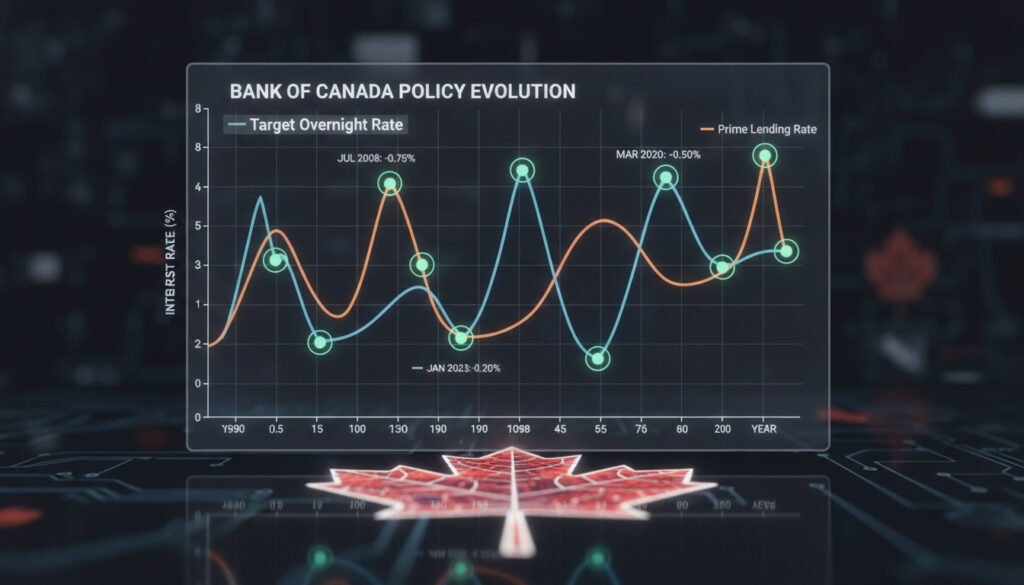
Bank of Canada Interest Rate History – Timeline, Charts and Key Changes
The Bank of Canada maintains its target overnight rate at 2.25% following the March 18, 2026 decision, marking three consecutive holds since October 2025. This policy interest rate, introduced in 1996, serves as the primary lever for controlling inflation toward the 2% target while influencing borrowing costs across the Canadian economy.
Understanding the trajectory of these rates reveals the central bank’s response to post-pandemic inflationary pressures, the subsequent disinflation cycle, and current economic stabilization. The current rate represents a significant reduction from the 5.00% peak observed during 2023 and early 2024.
This analysis examines the complete timeline of rate adjustments, the mechanisms behind monetary policy decisions, and the verified data surrounding Canada’s interest rate environment from 1975 to present.
What is the Complete History of Bank of Canada Interest Rates?
- The Bank has maintained the 2.25% rate across three consecutive decisions: October 29, 2025, January 28, 2026, and March 18, 2026.
- An aggressive hiking cycle commenced in March 2022, elevating rates from near-zero to 5.00% by late 2023.
- A cutting cycle began June 5, 2024, implementing nine reductions through October 2025.
- The target overnight rate framework replaced the floating Bank Rate system in 1996.
- Since 2000, rate announcements occur on eight predetermined dates annually to enhance policy transparency.
- The Bank Rate (upper band) currently stands at 2.50%, with the deposit rate (lower band) at 2.20%.
- The next scheduled announcement is April 29, 2026.
| Period | Rate | Context |
|---|---|---|
| March 2026 | 2.25% | Hold (third consecutive) |
| October 2025 | 2.25% | Cut -0.25 percentage points |
| September 2025 | 2.50% | Cut -0.25 percentage points |
| June–July 2025 | 2.75% | Extended pause |
| December 2024 | 3.25% | Cut -0.50 percentage points |
| October 2024 | 3.75% | Cut -0.50 percentage points |
| June–September 2024 | 4.75%–4.25% | Cutting cycle initiated |
| 2023–Early 2024 | 5.00% | Peak of recent cycle |
| March 2022–December 2022 | 1.00%–4.25% | Aggressive hiking phase |
| 1996 | Framework introduced | Target overnight rate established |
| Pre-1996 | Floating Bank Rate | Historical data from 1975 |
Bank of Canada Interest Rate Chart and Historical Data
The Modern Policy Framework (1996–Present)
The Bank of Canada adopted the target overnight rate as its primary monetary policy instrument in 1996. This framework replaced the previous floating Bank Rate system, establishing a clear benchmark for short-term borrowing costs. Since 2000, the Bank has announced rate decisions on eight fixed dates annually, typically Wednesday mornings, providing markets with predictable scheduling.
The overnight rate operates within a 50-basis-point operating band. The Bank Rate—the upper limit—currently sits at 2.50%, while the deposit rate occupies the lower band at 2.20%. The Canadian Overnight Repo Rate Average (CORRA), a benchmark for repo transactions, hovered between 2.27% and 2.32% in late March 2026, trading within the established band. Source
Pre-1996 Historical Records
Prior to 1996, monetary policy utilized a floating Bank Rate mechanism. Historical data extending back to 1975 remains available through the Bank of Canada and Statistics Canada archives, though direct comparison with modern rates requires understanding the methodological differences between the floating and target frameworks.
What is the Current Bank of Canada Key Interest Rate and Recent Changes?
March 2026 Decision
The Bank of Canada held the target overnight rate steady at 2.25% on March 18, 2026. This decision marked the third consecutive hold, following identical rates set on January 28, 2026, and October 29, 2025. The Governing Council cited continued progress toward the 2% inflation target and stable economic growth as factors supporting the pause. Source
The Bank implemented nine rate reductions between June 2024 and October 2025, lowering the policy rate from 5.00% to the current 2.25%.
The 2022–2024 Cycle
The current interest rate trajectory began with an aggressive hiking cycle in March 2022, designed to combat post-pandemic inflation. Rates climbed from 1.00% in April 2022 to the 5.00% peak maintained from October 2023 through April 2024. This represented the most rapid tightening cycle in recent history. Source
The prime rate, currently at 4.45%, directly influences variable-rate mortgages and home equity lines of credit (HELOCs). Fixed mortgage rates correlate with government bond yields rather than the overnight rate.
Upcoming Announcements
The next scheduled rate announcement occurs on April 29, 2026. Markets anticipate potential stability barring significant economic shocks, though the Bank maintains data-dependent flexibility. Source
Bank of Canada Rate Decisions: Economic Context and Reasons
Inflation Response (2022–2023)
The Bank of Canada raised rates aggressively starting March 2022 to address surging inflation. The cumulative increases between April 2022 and December 2023 aimed to cool demand and anchor inflation expectations toward the 2% target.
Disinflation and Growth (2024–2025)
By mid-2024, cooling inflation and softening economic activity prompted a reversal. The cutting cycle began June 5, 2024, with nine consecutive reductions through October 2025. By the third quarter of 2025, GDP growth reached 2.6%, an upside surprise that supported the subsequent pause in rate adjustments.
While inflation has neared the 2% target and GDP shows resilience, external trade developments and global economic conditions present ongoing uncertainties for monetary policy.
Transmission Mechanisms
Policy rate changes transmit through the economy via multiple channels. The Bank Rate and deposit rate create the operating band for wholesale funding. Retail banks adjust prime rates in response, affecting variable-rate mortgages, HELOCs, and business credit lines. Fixed-rate mortgages respond to shifts in government bond yields rather than direct policy changes. Historical data shows these correlations extending back decades.
When Did the Bank of Canada Last Change Interest Rates?
- : Held at 2.25% — Third consecutive hold following nine previous cuts.
- : Reduced to 2.25% (-0.25) — Final cut of the 2024-2025 easing cycle.
- : Reduced to 4.75% (-0.25) — Initiated the cutting cycle after 5.00% peak.
- : Held at 5.00% — Peak rate maintained through April 2024.
- : Increased to 2.50% (+1.00) — Largest single hike of the inflation-fighting cycle.
- : Increased to 1.00% (+0.50) — Early phase of aggressive tightening.
- : Framework introduced — Target overnight rate replaces floating Bank Rate.
- : Fixed dates established — Eight annual announcements scheduled for transparency.
What Do We Know About Future Rate Movements?
| Established Information | Uncertain Factors |
|---|---|
| Next announcement date: April 29, 2026 | Direction of next policy move |
| Current rate: 2.25% (since October 2025) | Magnitude of future adjustments |
| Inflation near 2% target | Timing of rate changes beyond April 2026 |
| Q3 2025 GDP growth: 2.6% | Impact of external trade shocks |
| CORRA trading within 2.27%–2.32% band | Long-term neutral rate estimates |
How Does the Bank of Canada Set Interest Rates?
The Bank of Canada operates under an inflation-targeting framework renewed every five years through agreement with the federal government. The 2% inflation target guides decisions on the overnight rate, which influences short-term borrowing costs throughout the financial system.
Eight fixed announcement dates occur annually, typically on Wednesdays, allowing markets to anticipate policy updates. Between these dates, the Bank may conduct extraordinary interventions during financial crises, though standard practice maintains the scheduled calendar.
While monetary policy manages credit conditions, other economic sectors face distinct pressures. For updates on federal service disruptions, see Canada Post Strike Status.
Where Does Bank of Canada Rate Data Originate?
Official rate decisions and historical data derive from the Bank of Canada’s Monetary Policy Committee announcements. Third-party aggregators including Trading Economics and Ratehub compile this data for comparative analysis.
Historical series extending to 1975 are maintained by the Bank of Canada and Statistics Canada, though pre-1996 data utilizes the floating Bank Rate methodology rather than the current target overnight rate framework.
What is the Current State of Bank of Canada Interest Rates?
The Bank of Canada maintains the target overnight rate at 2.25%, a level reached through nine cuts following the 5.00% peak of 2023-2024. This stabilization reflects successful disinflation and resilient economic growth of 2.6% in Q3 2025. With inflation approaching the 2% target and the next announcement scheduled for April 29, 2026, policy appears positioned for data-dependent stability. For the complete historical dataset, visit Bank of Canada Interest Rate History.
Frequently Asked Questions
How often does the Bank of Canada adjust rates?
The Bank announces rate decisions on eight fixed dates annually, typically Wednesday mornings, though emergency adjustments can occur between scheduled meetings during financial crises.
What is the Bank of Canada’s key interest rate called?
The official term is the target overnight rate, also referred to as the policy interest rate. It serves as the primary tool for implementing monetary policy.
What is the impact of Bank of Canada rate changes on mortgages?
Changes directly affect the prime rate, influencing variable-rate mortgages and HELOCs. Fixed-rate mortgages correlate with government bond yields rather than the overnight rate.
What is the difference between the Bank Rate and the target overnight rate?
The Bank Rate represents the upper limit of the 50-basis-point operating band (currently 2.50%), while the target overnight rate (2.25%) sits at the center. The deposit rate forms the lower band (2.20%).
What was the highest Bank of Canada interest rate in the recent cycle?
The recent peak reached 5.00%, maintained from October 2023 through April 2024 before the cutting cycle began in June 2024.
What is CORRA?
The Canadian Overnight Repo Rate Average (CORRA) is a benchmark interest rate for repo transactions. In late March 2026, it traded between 2.27% and 2.32%, aligning with the policy rate band.
How far back does Bank of Canada interest rate data extend?
Historical data is available from 1975, though the modern target overnight rate framework began in 1996. Pre-1996 data uses the floating Bank Rate methodology.
More related posts
 Michael Schumacher: Condition, Accident & Latest Updates
 Income Tax Brackets Canada 2025: Federal & Ontario Guide
 Andrew Coyne’s Family Ties to the Trudeaus, Explained
 Redmi Note 9 Pro 5G to Buy in 2024: Price & Worth It
 How Much Melatonin Is Too Much? Safe Dosage Guide
 Latest Breakthroughs in Quantum Computing 2024: Stocks & Safety
 Tour de l’Île Montréal 2025 Map: Routes, Date & Schedule
 TV Shows with Graham Greene (Actor): Verified Roles
